Mauro Colagreco: “My cuisine is borderless because I believe that creativity has no limits.”
This is one of the portraits of great chefs that we create for our food tours and city guides.
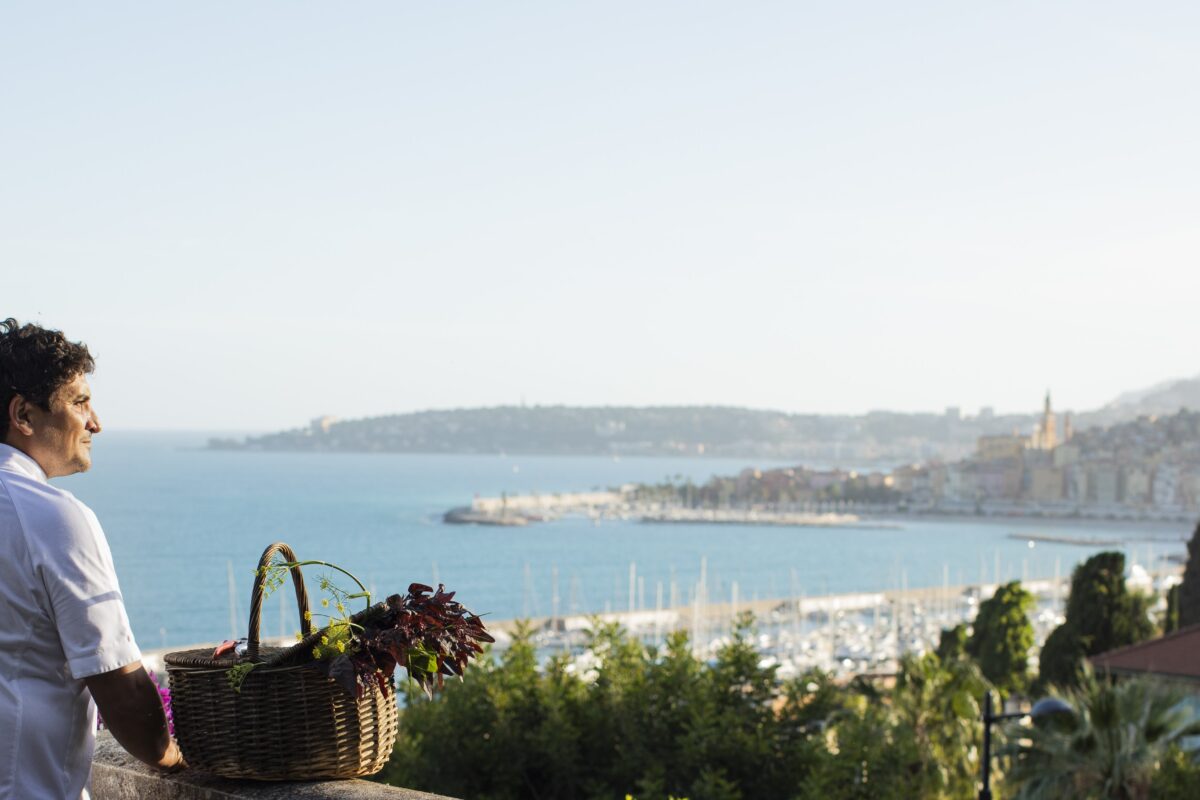
Mauro Colagreco was born in La Plata, a university city near the Argentine capital. The twists of fate brought him to Menton, on the French Riviera, where he established Mirazur, considered the best restaurant in the world in 2019 by the prestigious “The World’s 50 Best Restaurants” list and now holding three Michelin stars. He has lived in France for almost two decades: during this time, he started many other gastronomic projects and, besides creating teams of excellence, developed a concern for the environmental impact of his work. This concern led Mirazur to become, in January 2020, the first restaurant in the world to eliminate plastic.
His concern generated a highly positive ripple effect. Other establishments followed his path, encouraged by the idea that what initially seems impossible can be achieved with determination and the support of a highly competitive team. In this interview, the chef talks about his philosophy as an entrepreneur, the influences of Latin American culinary culture in his work, and the journey that led him to become a biodiversity ambassador for UNESCO.
You are a great source of inspiration for many chefs and entrepreneurs arriving in a new country and have become an undisputed reference on the international scene. Did you imagine this at the beginning of your career as a chef?
Of course, the answer is no! It was a crazy and wonderful adventure. I hadn’t even imagined staying in France when I arrived in 2001. I came after studying cooking in Buenos Aires, encouraged by my teachers to obtain a degree and have a two-year culinary experience in the “Mecca of gastronomy.” Initially, the plan was to return to Argentina.
As the saying goes: man proposes, and destiny disposes… The succession of opportunities, experiences, and encounters led me to decide to stay in France and eventually open my own restaurant here. By pure chance, I found Mirazur, now my restaurant on the Côte d’Azur. It had been closed for years in this small but beautiful town called Menton. The building is incredible, a rotunda overlooking the Mediterranean Sea, with an impressive view, just steps from the Italian border, where my grandparents are from.
I didn’t know Menton, but it became something like my place in the world, my home since 2006; it will soon be 20 years since I moved here!
What were the biggest challenges you faced to establish yourself on the French culinary scene?
I was always very well received in France. Of course, my path has been that of a passionate person to the end, with a lot of hard work, from the beginning to today.
I consider that I had wonderful opportunities and was ready to seize them and take control of my destiny. I was also lucky: I met wonderful people and, although I could have been afraid, I never let it stop me from seizing those precious moments that marked my career; as my father used to say, “the champion’s luck.”
Each time was like starting over, with no certainty of success, often quite the opposite. It was my desire to excel and my passion for this profession, along with my family and friends who supported me, that made this great adventure possible.
When I arrived on the Côte d’Azur to open my own restaurant, I had no contacts, no money, didn’t know the region, the products, or the producers. I went out to meet people, to discover the landscape, and started from scratch. It was a very human experience but also very difficult at first, and I think it’s important to say that… And just when I had finally resigned myself to closing, the first Michelin star came. That lucky star saved me!
As for challenges, there are still many… it’s a recurring part of life, today they are of a different nature, but they are still great challenges, because we are in a continuous process of improvement.
To give an example, when I decided to eliminate all single-use plastic from our kitchen, it seemed totally utopian and unrealistic. Imagine simply removing cling film… But we invested three years of deep and constant work in research, training, and communication with our teams and suppliers, and we succeeded! In January 2020, we obtained certification and became the first plastic-free restaurant in the world.
It immediately inspired other establishments to follow this path out of curiosity and the desire to commit. Today, with our circular gastronomy, we try to follow that same philosophy, demonstrating that we can’t say “this is impossible.”
What Latin American influences accompany your cuisine, and what dishes, in your opinion, represent them?
I consider my cuisine to be without borders, without nationalities, because I believe that creativity has no limits. For me, creation must remain a field of freedom for our deep selves; that mental space where we are able to sublimate our knowledge, desires, and impulses.
If I have to think about influences linked to my origins, the first thing that comes to mind is the notion of sharing that is rooted in my Latin roots and my childhood memories. The pleasure of gathering around the table, food as a gift, generosity in simplicity.
This feeling has deeply inspired me, and I wanted to pay homage to this legacy of the heart by creating, for example, “sharing bread,” which is the first food served at the table, only with olive oil and Pablo Neruda’s “Ode to Bread.” It is the inaugural moment of the experience at the table in Mirazur and comes directly from my life in Argentina, from my childhood and adolescence there. But above all, from my desire to affirm that gathering around a table is a unique moment of communion with ourselves, with others, and with nature.
Another inspiration I have received from my family heritage is the love for travel, for knowing other cultures, for discovering the different, letting oneself be surprised, trying to approach, interpret, and understand it. So, I give myself the freedom to use all the world’s influences when creating.
But my guiding thread, the great inspiration for all my establishments, whether high gastronomy, burger, or pizza, is the excellence of the products and respect for nature. That the dish is capable of reconnecting us with the earth, of marveling at the beauty of nature, that is my greatest influence and inspiration.
Your culinary philosophy includes a fundamental dimension of sustainability and commitment to the environment. Do you remember a moment or episode when you realized the importance of committing to this cause?
I believe there is a basic sensitivity that was passed on to me by my family, by my culture. My grandparents lived in the countryside; my three sisters and I regularly visited them on the farm, and we loved it! My father always found time for his garden, to take care of a few tomatoes, peppers, and make a small vegetable garden in the city. In our travels, we prioritized walks in nature, the grand landscapes of Argentina, meeting the locals… all of that is part of my memories, all of that is still working within me.
There have also been strong moments of awareness and awakening, such as reading the book “The One-Straw Revolution” by Masanobu Fukuoka. He is considered the father of permaculture, and he really gave me the will and impetus to develop my own gardens in permaculture and biodynamics. Today we have 5 hectares that largely supply Mirazur, between 60% and 80%, depending on the season.
Of course, there were also more difficult moments, like a trip to Mexico and the desolation of walking on paradisiacal beaches, difficult to access and yet full of all kinds of plastics. After that trip, I promised my children to do something about it and decided to eliminate single-use plastics from our kitchens.
But to end on a positive note, our work in the gardens led us to the discovery of ancient plant seed varieties, and we committed to the conservation and development of cultivated biodiversity. It is very important for me to defend this biodiversity, and now I have the support of UNESCO, which named me a Goodwill Ambassador. These advances encourage me to keep going!
As with any virtuous process, we always have new commitments, new projects, enriching encounters.
What are your professional goals? Are there particular projects that excite you at the moment?
I believe my profession is a life journey, and my intention is always to surpass myself, to step out of my comfort zone to face new challenges.
My role as a biodiversity ambassador for UNESCO motivates me a lot, and I believe it is a wonderful opportunity to affirm the deep connection between food and the continuity of life. I think it’s essential to communicate the impact of our choices on our environments and the planet.
We also have a project that excites me a lot, which is the creation of a circular farm in the interior of Menton, which we will develop very soon. It is an ambitious project, a place to experiment and live in direct reconnection with the earth. A space for training in circular cuisine, with hands in the soil.
What advice would you give to young Latin American chefs aspiring to succeed in international cuisine and to entrepreneurs starting their careers in another country?
To hold on to their dreams, to never abandon their deepest motivations, and never work just for the rewards. Of course, they are important; they allow us to value our work before a wider audience, communicate better, and motivate our teams… but they should never become the only goal.
Indeed, our work is much deeper and more wonderful; it plays out daily, in our environments, in our communities, with our suppliers, with every creation and every customer experience.
Our work, beyond being a profession, must give meaning to our lives. It should elevate our spirits, leave a more harmonious mark on our surroundings, and make peace with nature!
The Mirazur Experience
Mirazur operates in a building built in the 1930s. Colagreco’s team works there to offer diners a unique gastronomic experience. The place clings to the mountain and overlooks the Mediterranean. At Mirazur, there is no menu: the options change daily, as the dishes are made with products from their garden and what the fisherman gets that day. 95% of the products used are local, to respect the inhabited space, its seasons, and timings. Among the specialties diners highlight in various reviews are the quinoa risotto, forest mushrooms, and Parmesan cream. Being by the sea, the daily fish dishes are obviously a strong point. They can be accompanied, for example, by the celebrated celery root puree and smoked sauce.
Mirazur is located at 30 Av. Aristide Briand, 06500 Menton, France. To visit, prior reservation is required.
BRASSERIE GRAND COEUR
Discover the charming brasserie Grandcoeur, located in a beautiful cobblestone courtyard in the heart of the Marais. The terrace, with a privileged view of the neighborhood’s dance studios, is my favorite spot.
41 rue du Temple 75004 Paris
Monday to Sunday from 12:00 to 14:30 and 19:15 to 22:30 RSVP: grandcoeur.paris | 01 58 28 18 90
ANAHI
Anahi traverses the ages and continually reinvents itself. Initially, it was a neighborhood Argentine restaurant. Then, Carmen Lebrero, a charming woman and the soul of the place, transformed it into an essential refuge for Parisian nights during the ’90s and early 2000s. The “cantina” for fashion personalities where designers and top models from all over the world gathered for dinners as intimate as festive until the curtain fell. In 2017, Riccardo Giraudi, an importer of exceptional meats and a globetrotter, a regular customer of the place, took it over and invited chef Mauro Colagreco, who created a menu marked by his origins and childhood memories, such as the asado.
They also offer cocktails in an intimate atmosphere that surprises with its variety and creativity. For the Olympic Games, they designed proposals to celebrate.
49 Rue Volta, 75003 Paris
Tuesday, Wednesday, and Thursday from 19:00 to 23:00 Friday and Saturday from 19:00 to 23:30
RSVP: contact@anahi-paris.com | +33 18 38 13 800